
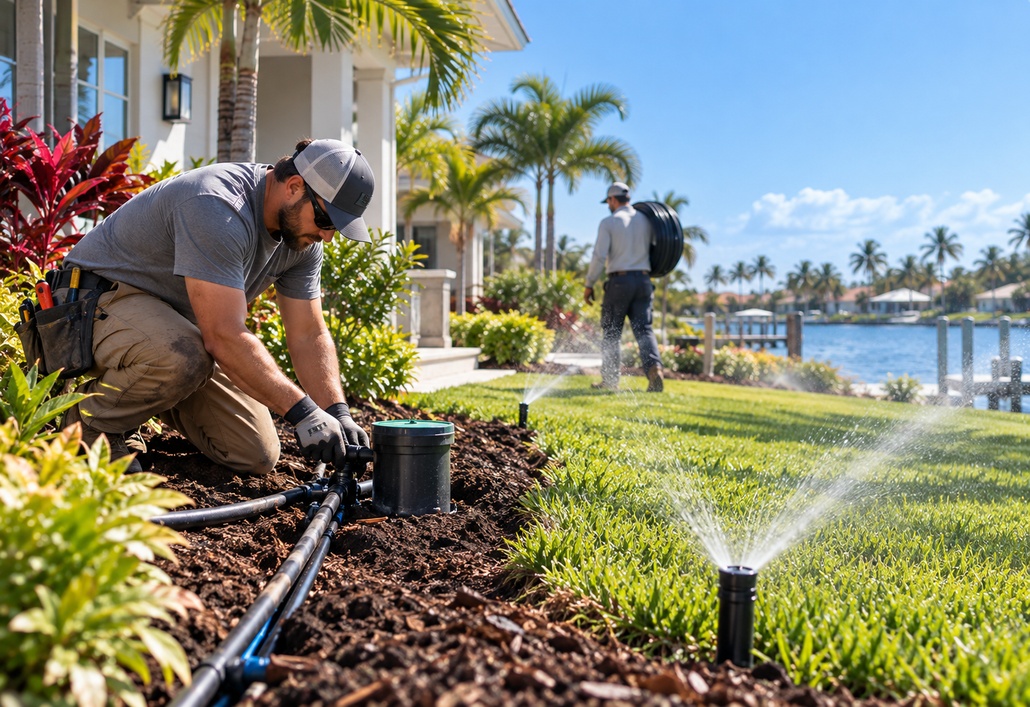
A professionally installed irrigation system takes the guesswork and the manual labor out of keeping a Melbourne lawn healthy through Florida's dry season and its summer deluges alike. If patchy grass and hose-dragging have become your weekend routine, Citrus Landscape Solutions can walk you through what a proper system looks like for your property. Call (407) 759-1260 or schedule a site assessment online to get started.
Melbourne homeowners deal with a specific set of irrigation challenges. Brevard County's climate swings between dry stretches in winter and spring and the kind of summer rainfall that can drop several inches in an afternoon, and a yard that looks fine after a rainy week can brown out quickly when the rain stops and the heat builds. Manual watering covers some of that gap but rarely covers it evenly or efficiently, which is why lawns watered by hand tend to show stress in the same patches year after year. Here is what to expect when you hire a professional irrigation installer and how the process works from site assessment to working system.
How Are Irrigation Zones Mapped to Sun Exposure and Plant Needs?
A properly designed irrigation system does not treat the entire yard as a single zone. Sun exposure, plant type, soil conditions, and the slope of each area all affect how much water different parts of the property need and how quickly that water is absorbed or runs off. A front lawn facing full afternoon sun on the west side of a Melbourne home dries out faster than a shaded bed along the north fence line. Watering both areas on the same schedule and at the same rate means one is consistently overwatered while the other stays dry, which is exactly the uneven result that most homeowners with manual watering are already experiencing.
Zone mapping begins with a site assessment that walks the property and identifies the distinct water-need areas. Turf zones are typically separated from planting bed zones because grass and ornamental plants often have different watering requirements and respond better to different head types. A rotor head that distributes water across a broad arc works well for open lawn areas but is the wrong tool for a narrow planting bed where it will water the fence more than the plants. Drip emitters or micro-spray heads in planting beds deliver water directly to the root zone of each plant, which reduces waste, reduces fungal pressure from overhead watering on foliage, and gives each plant what it actually needs rather than what the lawn next to it needs.
In Melbourne's mix of sandy coastal soil near the Indian River Lagoon and heavier inland soils, infiltration rates vary enough across a single property that zone design needs to account for it. Sandy soil absorbs water faster but holds it for a shorter time, which generally means shorter, more frequent run times in sandy areas. A site assessment by an experienced installer identifies these variations and designs around them rather than applying a uniform schedule across the whole system.
How Do Smart Controllers and Rain Sensors Cut the Water Bill?
A timer that runs the system on a fixed schedule regardless of what the weather has been doing is the baseline of irrigation control, and it is also the configuration most likely to waste water. A system that runs its full Tuesday schedule the morning after a two-inch Monday afternoon rainstorm is not irrigation. It is drainage practice on a lawn that does not need more water. Florida's water management districts and local utilities have increasingly restricted irrigation schedules precisely because fixed-schedule systems have historically added significant unnecessary demand to the water supply.
Rain sensors interrupt the scheduled watering cycle when precipitation exceeds a set threshold, preventing the system from running on a day when natural rainfall has already done the job. Florida law requires rain sensors on new irrigation systems, and any installer who is not including one in a new installation is not building the system to code. Beyond the legal requirement, a properly calibrated rain sensor pays for itself relatively quickly in reduced water consumption and the associated reduction in the utility bill.
Smart controllers go further by connecting the irrigation schedule to real-time and forecast weather data, adjusting run times based on evapotranspiration rates that reflect actual temperature, humidity, and sun conditions rather than a static schedule. A smart controller running a Melbourne lawn through a mild overcast week will water less than it does during a dry, sunny stretch, automatically. For homeowners who want to minimize ongoing management of the system after installation, a smart controller is the component that makes that possible. The controller makes the day-to-day decisions, and the homeowner sees the result in a healthier lawn and a lower water bill without having to monitor the forecast and adjust the timer manually.
What Does a Professional Installation Include Versus a Cheap Patch Job?
We worked with a retired Melbourne homeowner who had spent years manually watering his garden and was ready for a change. The physical routine of moving hoses from bed to bed had become more work than he wanted, and he was not sure whether an irrigation system would actually solve the problem or just add complexity. We explained how a thoughtfully designed system, zoned to match what each part of his garden actually needed, would not only eliminate the hose work but would water more consistently and more efficiently than he had been doing by hand. The system we installed gave him back his weekends and kept his garden better watered than it had ever been through manual effort.
That outcome reflects the difference between a professional installation and the kind of quick-and-cheap system that does not hold up or perform as expected. A professional installation includes a site assessment before design begins, a zone layout that matches the property's actual water needs, properly spaced heads calculated for the right coverage pattern, trenched lines installed at the correct depth, a backflow preventer that meets code, and a controller programmed to the property's specific conditions. The installer pulls the necessary permits, the system passes inspection, and the homeowner receives documentation of the installation that matters for insurance and future service calls.
A cheap patch job typically means heads spaced for coverage efficiency on paper rather than for the property's actual layout, lines run at inadequate depth that shift and break when the lawn is aerated or edged, no backflow prevention or a non-compliant device, and a controller set to a generic schedule that may or may not fit the property. These systems appear to work initially and develop problems over months and years that require repair visits that add up to more than the cost difference between the two installation approaches would have been in the first place. The permitting and inspection process exists precisely to catch the installation shortcuts that create those downstream problems.
What Are the Permitting and Backflow Basics in Brevard County?
Irrigation installation in Brevard County requires a permit from the county's building department for systems connected to a potable water supply, and the installation must be performed by a licensed irrigation contractor. The permit process requires a site plan showing the zone layout, head placement, and controller location, and a final inspection confirms that the installed system matches the approved plan and meets the applicable code requirements, including the rain sensor requirement and the backflow prevention requirement.
Backflow prevention is a plumbing code requirement that protects the public water supply from contamination. An irrigation system connected to the household water supply creates a potential pathway for irrigation water, which may contact fertilizers, pesticides, or soil, to flow back into the potable water line under certain pressure conditions. A properly installed backflow preventer, matched to the type of connection and the local water authority's requirements, eliminates that pathway. Brevard County utilities inspect backflow preventers on a regular cycle, and a non-compliant or missing device can result in service interruption until the violation is corrected.
A licensed contractor handles the permit application, the installation to code, and the coordination with the inspector as a standard part of the job. The homeowner does not need to manage the permitting process independently. What they receive at the end is a permitted, inspected system with documentation on file that confirms the installation met code, which matters when the property is sold and when service or expansion is needed years down the line.
If you are ready to replace the hose routine with a system that waters your Melbourne lawn correctly without the weekend labor, call Citrus Landscape Solutions at (407) 759-1260 or request a site assessment online. Our irrigation system installation and landscape design services are built around what your specific property actually needs rather than a one-size system that waters the driveway as much as the lawn.