A professional paver driveway goes in five stages: grading and excavation, a compacted base, a sand setting bed, laying the pavers, and locking in the edges. Most of the work happens before a single paver touches the ground, and that hidden work decides how long the driveway lasts.
Here is how the job really goes, step by step. If you would like to talk through your own driveway, reach out to our team or call (407) 759-1260.
What happens during grading and excavation for a paver driveway?
The crew removes the old driveway, digs out the area to the right depth, and shapes the ground so water flows away from your house and garage. This stage sets up everything that follows.
If you have an old concrete or asphalt driveway, it gets broken up and hauled away first. Then the soil underneath is excavated deep enough to make room for the base, the sand, and the pavers, with the finished surface landing at the right height against your garage slab.
Grading is the part most homeowners never think about. The ground needs a gentle slope, usually toward the street or a drainage area, so rain does not pool by the garage door. In Suntree, where many driveways sit on nearly flat lots, getting that slope right takes careful measuring.
Our grading and leveling work makes sure the ground is shaped correctly before any base material goes down. Skip this, and every step after it is built on a mistake.
Why does the compacted base matter so much?
The base is what actually carries the weight of your car. A properly built base spreads that load evenly so the pavers stay level for years. A thin or loose base lets them sink under the tires.
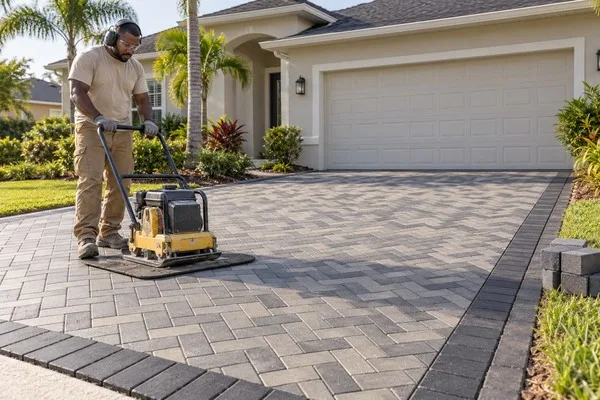
The crew spreads crushed stone in layers and compacts each one with a plate compactor before adding the next. Doing it in layers matters. Dumping the full depth at once and compacting only the top leaves soft spots underneath that settle later.
Florida's sandy soil makes this step even more important. Sand shifts when it gets wet, and without a solid, compacted base on top of it, a driveway near busy roads like Wickham Road can develop ruts where cars turn in and out every day.
This is where cheaper bids often cut corners. A shallow base saves a contractor time and material on day one. You pay for it later, when the pavers start dipping in the tire tracks.
How are the sand bed, pavers, and edge restraints installed?
A thin, smooth layer of bedding sand goes over the base, the pavers are laid in your chosen pattern, and a firm edge restraint locks the outside rows in place. Then joint sand is swept in and the whole surface is compacted again.
The sand layer is screeded perfectly flat. It is not there to fix low spots in the base. It simply gives each paver a level seat. If a crew uses extra sand to hide an uneven base, the pavers will eventually settle into those dips.
Laying is the part everyone pictures. Pavers are set tight in the pattern, with cuts made along the edges and around obstacles. Older homes near downtown Melbourne often have curved approaches and mature trees, so those cuts take extra care.
Edge restraints are the last structural step. Without them, the outer rows slowly creep outward and the joints open up. Joint sand fills the gaps, and a final pass with the compactor locks everything together.
How long does a paver driveway installation take, and what does skipping steps cost?
A typical residential driveway takes several days, depending on its size, the removal of the old driveway, and the weather. Rain can pause excavation and base work, because compacting wet material is not a step worth rushing.
One of our customers sat in a lawn chair watching us work, wondering when the fun part would start. We explained what goes into a paver installation and what happens underneath. After the first heavy rain, he was thrilled. The puddle that always formed next to his car was gone.
That is the payoff of doing every step right. Skipping base or leveling work does not show up on installation day. It shows up months later as sinking, shifting pavers and water pooling where it always did.
Our paver installation in Melbourne follows the full sequence on every driveway, from grading to the final compaction.
Ready to see what your new driveway would cost? Call Citrus Landscape Solutions at (407) 759-1260, or request a firm quote and we will come measure your driveway.