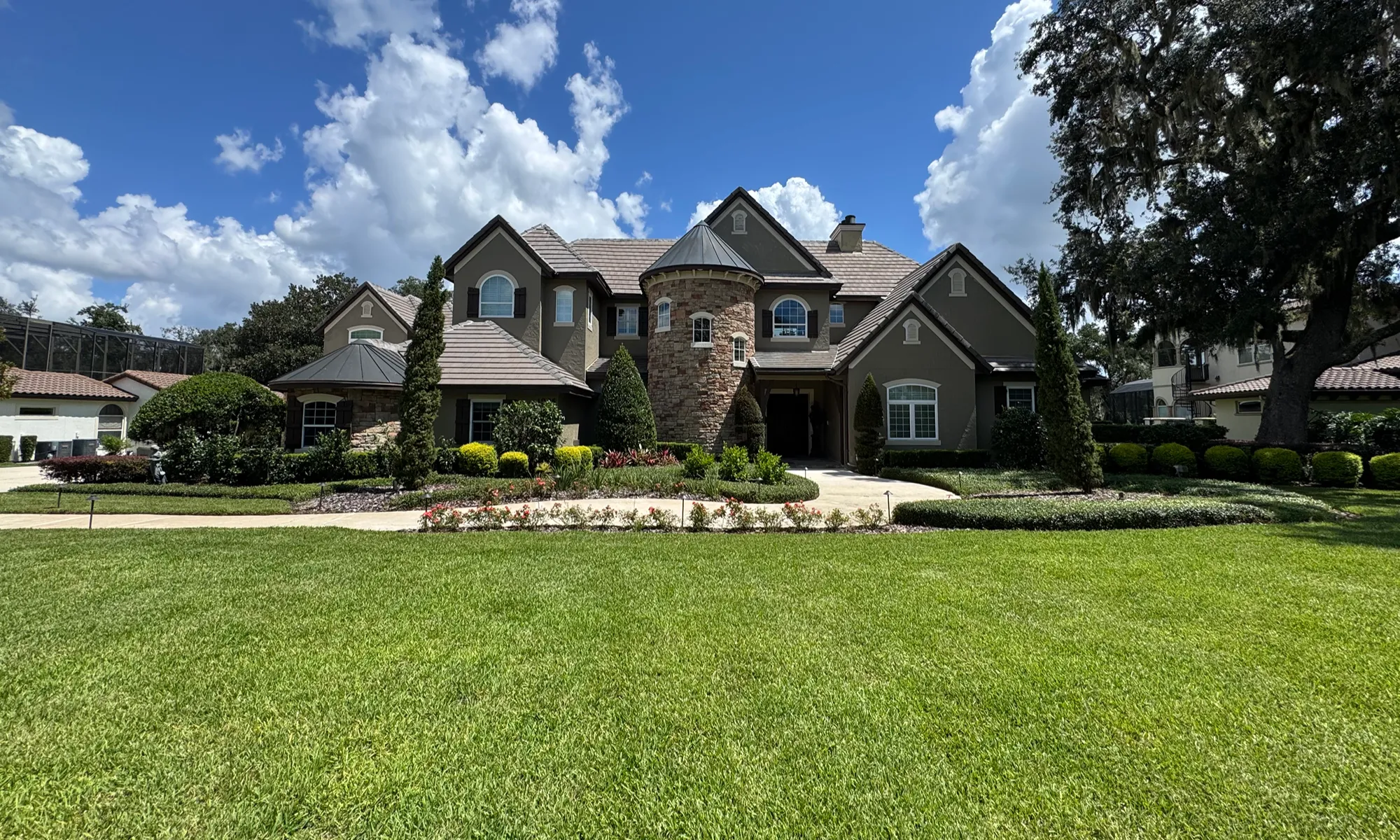

A high-end Melbourne property deserves a maintenance program as deliberate as the landscape design itself, managed by one accountable team rather than a collection of vendors whose schedules and standards never quite align. Citrus Landscape Solutions offers full-service estate maintenance built around what luxury properties actually require. Call (407) 759-1260 or schedule a walkthrough and custom care plan to see what that looks like for your property.
Melbourne's luxury residential neighborhoods along the Indian River Lagoon and in the established communities near Brevard County's barrier island communities include properties whose landscape programs involve specimen plantings, mature palms, irrigation systems serving multiple zones, landscape lighting networks, and seasonal color programs that rotate throughout the year. Managing all of those elements through separate vendors means separate scheduling conversations, separate accountability when something is not right, and the inevitable gaps that appear when one vendor's work affects another's scope without anyone taking responsibility for the overlap. A single-team estate maintenance program eliminates that structure and replaces it with one point of contact who knows the property in its entirety.
What Does Horticultural Care for Specimen Plants and Palms Actually Involve?
The specimen plants and mature palms on a luxury Melbourne property represent years of growth and significant investment, and maintaining them at their best requires more than mowing around them. Each specimen has specific requirements for pruning timing and technique, fertilization schedule, pest and disease monitoring, and irrigation management, and those requirements vary by species, age, and the specific microclimate of its location on the property.
Palm care in Brevard County's coastal environment is a representative example of why horticultural knowledge matters in estate maintenance. Sabal palms, Royal palms, Bismarck palms, and the various Phoenix species all have different frond removal protocols, different nutrient requirements, and different vulnerabilities to the fungal and nutritional problems that Florida's climate produces. Over-pruning a palm, which some maintenance crews do to reduce debris, removes the fronds that are still photosynthesizing actively and stresses the tree in ways that accumulate over time. Under-fertilizing a palm in Brevard County's sandy, nutrient-poor soils produces potassium deficiency symptoms that progress to permanent crown damage if not caught early. A maintenance team that understands these distinctions and applies them to each palm on the property individually produces noticeably different results than one that treats all palms the same way on the same schedule.
Specimen shrubs and ornamental trees receive similar individualized attention in a full-service estate program. Pruning timing for flowering specimens should correspond to the plant's bloom cycle rather than a blanket schedule, because pruning at the wrong time removes the buds that produce next season's flowers. Fertilization schedules account for the specific nutritional needs of each species and the season. Pest and disease monitoring during routine visits catches problems before they become visible damage, which is the difference between a treatment that costs a modest amount and a replacement that costs substantially more.
How Are Irrigation and Lighting Systems Managed as Part of Ongoing Maintenance?
An irrigation system that is not actively managed degrades in performance over time even when nothing is visibly broken. Head alignment shifts, emitter flow rates change as mineral deposits accumulate, controller programming becomes misaligned with actual plant water needs as seasons change, and small leaks or pressure losses develop without producing obvious symptoms. An estate maintenance program that includes irrigation monitoring and adjustment as a standard function rather than an emergency-only service maintains the system's performance between formal inspections and catches developing issues while they are still inexpensive to correct.
Seasonal irrigation adjustment is particularly important in Melbourne, where the transition between Brevard County's dry season and wet season requires meaningful changes to the controller schedule and zone run times. A system running its summer schedule through the dry winter and spring months wastes significant water and over-irrigates in ways that can promote root disease in susceptible species. A system carrying its dry-season schedule into the summer wet season provides insufficient coverage during the hottest, most stressful period for the landscape. Monthly monitoring and seasonal adjustment by the maintenance team keeps the system calibrated to actual conditions rather than to whatever schedule was last programmed.
Landscape lighting systems require similar ongoing attention to maintain the effect they were designed to create. Fixtures shift, bulbs fail, timer settings drift from daylight saving time changes, and overgrown plant material gradually obscures fixtures that were once positioned correctly relative to the feature they were illuminating. A maintenance team that includes lighting system checks as part of the regular service schedule keeps the system performing as intended without requiring the homeowner to notice and report each individual issue as it develops.
What Do Seasonal Color Rotations and Detailing Standards Look Like at the Estate Level?
We worked with a Melbourne luxury homeowner who had been managing her landscape through multiple separate vendors for years and had reached the point where the coordination overhead had become as frustrating as any individual vendor's shortcomings. Someone for lawn maintenance, someone else for seasonal plantings, another contact for irrigation issues, and no single person who understood the property as a whole or felt accountable for how it looked overall. When we took over the full program, she had one contact, one schedule, and one team that knew every element of the property. The relief that came with that simplicity was, by her account, as valuable as the quality of the work itself.
Seasonal color management at the estate level goes well beyond selecting and planting annuals. It involves designing rotations that maintain visual continuity through the transition between seasons, selecting plant material that performs reliably in Melbourne's coastal environment rather than defaulting to varieties that look good in a nursery but struggle in Brevard County's humidity and salt air, and timing installations so that beds are never empty or spent-looking during the periods when the property receives the most social activity. A homeowner who entertains regularly in October and March has different color rotation priorities than one whose peak activity is December and July, and a maintenance team that understands those patterns designs the program around them.
Detailing standards at the estate level cover the elements that separate a well-maintained landscape from an immaculate one. Mulch depths refreshed before they become thin and weedy rather than after. Bed edges re-cut with a clean vertical face rather than allowed to gradually become undefined. Hardscape surfaces blown clean after every service visit rather than only when debris is heavy. Irrigation heads checked for proper arc and height after mowing rather than left to be discovered during an obvious dry patch. These details do not require more time in aggregate so much as they require consistent attention to a higher standard, and that standard needs to be built into the maintenance program explicitly rather than assumed.
How Does Single-Point Scheduling and Reporting Work for Estate Properties?
The administrative value of a full-service estate maintenance program is as real as the horticultural value, and it is the dimension that homeowners who have previously managed multiple vendors appreciate most immediately. A single account manager who knows the property, coordinates all service visits, and is reachable when something needs attention replaces the friction of identifying which vendor is responsible for a given issue and whether that issue falls within or outside each contractor's stated scope.
Reporting from a full-service program documents what was done on each visit, what the maintenance team observed that warrants attention, and what was addressed during the visit or flagged for follow-up. A homeowner who is frequently traveling, or who simply prefers to receive information rather than inspect the property after every service visit, gets a consistent record of what is happening with the landscape without having to be present for it. That documentation also builds over time into a record of what the property's seasonal patterns look like, what treatments have been applied, and how different areas of the landscape respond to different conditions, which informs better decisions about the care plan as the relationship develops.
If you are ready to consolidate your Melbourne estate's landscape maintenance under one accountable team, call Citrus Landscape Solutions at (407) 759-1260 or schedule a property walkthrough online. Our landscape maintenance program and plants and design expertise work together to keep your property at the standard it deserves, managed by people who know it as well as you do.