A commercial landscape maintenance contract should mean one less thing on a property manager's list, not a recurring source of follow-up and frustration. If your current crew is inconsistent or your property never quite looks the way it should, Citrus Landscape Solutions is worth a conversation. Call (407) 759-1260 or request a property assessment and proposal online to see what a dependable maintenance partnership actually looks like.
St. Petersburg property managers and business owners comparing landscape maintenance contractors are often not looking for the cheapest option. They are looking for the one that shows up consistently, does the full scope without being asked twice, and makes the property look like someone is paying attention to it. That description sounds basic, and it is. The frustrating reality is that finding a commercial landscape partner who delivers on it reliably is harder than it should be, and the cost of the wrong choice shows up in ways that go beyond an unkempt lawn.
What Scope Items Belong in a Commercial Landscape Maintenance Contract?
A commercial maintenance contract that does not specify scope in detail is a contract that will generate disputes. The ambiguity about what is and is not included is exactly where the gap appears between what a property manager expects and what the crew delivers, and that gap tends to widen over the life of a contract as the crew defaults to minimum effort while the manager's expectations remain where they started.
A well-written commercial landscape maintenance contract specifies the service frequency for mowing, edging, and trimming, not as a general interval but as a defined schedule tied to the growing season. In Pinellas County, turf growth rates in the summer months require more frequent service than in the cooler months, and a contract that does not account for that variability either over-services in winter or under-services in summer. The contract should specify what constitutes a complete service visit: mowing at the correct height for the turf species, edging at all hard surfaces and planting bed borders, trimming shrubs and ornamentals to defined limits, blowing clippings from all paved areas, and removing debris from the property as part of the standard visit rather than as a separate billable item.
Irrigation oversight belongs in the contract as a defined responsibility, not as an add-on the crew addresses only when something is visibly wrong. St. Petersburg properties experience both drought conditions in winter and spring and excess moisture during summer rain periods, and an irrigation system that is not adjusted seasonally wastes water during the wet season and allows turf stress during the dry season. A maintenance contract that includes irrigation monitoring and controller adjustment as a standard function produces a more consistent landscape result than one that treats irrigation as outside the scope.
Why Do Crew Consistency and Response Times Matter More Than Price?
An office manager contacted us recently in genuine frustration after cycling through multiple landscape contractors over a period of years. The most recent episode had crystallized exactly why crew consistency matters: she had international clients flying in for a significant meeting, and the landscape company that was supposed to have serviced the property the day before had not shown up. The grounds were covered in leaves and storm debris, and there was no answer when she called. The property looked neglected on exactly the day it needed to look its best.
That situation is not rare, and it illustrates something important about what commercial landscape service actually delivers. The technical work of mowing and trimming is a commodity. Reliability at the moment it matters is not. A crew that performs adequately when conditions are convenient and disappears when there is a scheduling conflict, a staff shortage, or competing priorities elsewhere on their route is a crew that will eventually fail a property manager at the worst possible time. The cost of that failure, measured in client impressions and staff time spent managing the crisis, often exceeds the cost difference between a reliable contractor and a cheaper unreliable one many times over.
Crew consistency also affects the quality of the work over time. A team that services the same property repeatedly develops familiarity with the planting beds, the irrigation zones, the areas that accumulate debris after wind events, and the specific characteristics of the turf and ornamentals on that property. A rotating crew of different workers sees the property fresh each time and performs to a generic standard rather than the specific standard the property requires. Ask any commercial contractor you are evaluating whether the same crew services a property consistently and what the protocol is when that crew is unavailable. The answer reveals how seriously the contractor takes accountability at the property level.
How Should Seasonal Color and Irrigation Oversight Be Handled?
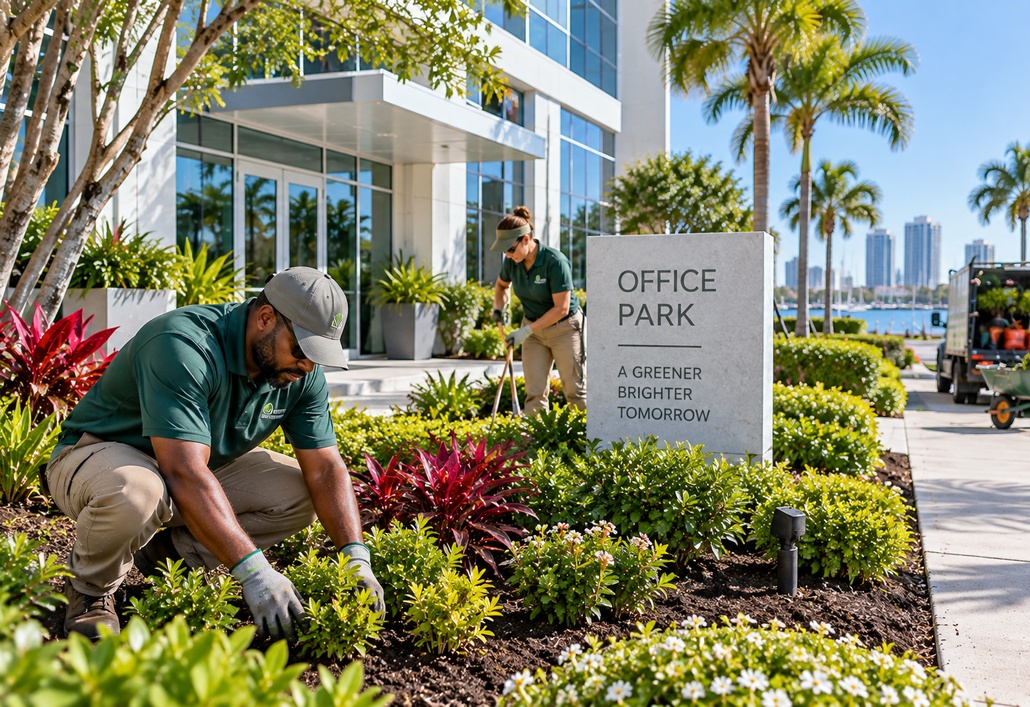
Seasonal color plantings are one of the most visible elements of a commercial landscape and one of the most reliable indicators of whether a property is being actively managed or simply maintained. A property with fresh, appropriate seasonal color in the entry planters and high-visibility beds signals active management. A property with spent annuals left in place past their season, or empty beds between rotations, signals the opposite. For tenants, clients, and prospects approaching the building, that distinction registers before they reach the front door.
A commercial landscape partner who takes responsibility for seasonal color manages the selection and timing of rotations based on St. Petersburg's growing conditions, which differ from those of cooler climates and require planting schedules calibrated to Pinellas County's mild winters and hot, humid summers. Impatiens that perform well in spring and fall struggle through the humidity of a Florida summer. The right plant selection for each season is knowledge that a locally experienced contractor brings automatically rather than learning at the property manager's expense through failed plantings.
Irrigation oversight during seasonal transitions is particularly important because the water needs of fresh plantings differ from those of established turf and mature shrubs. A new color rotation needs more frequent irrigation during establishment than the mature plants in the same zone, and a smart controller or a manually adjusted schedule can account for that difference without overwatering the surrounding planting. A landscape partner who leaves the irrigation schedule unchanged through seasonal color rotations is setting the new plantings up for either drought stress or fungal pressure depending on the season, and either outcome reverses the investment the color rotation was supposed to deliver.
How Does Curb Appeal Affect Tenant Retention and Leasing?
Commercial property research consistently shows that exterior appearance affects tenant decisions at the leasing stage and retention decisions at renewal time, and the effect is strongest for office properties where the building's image reflects on the tenants' professional reputation. A tenant whose clients visit the property regularly has a direct interest in how the grounds look, and a property that consistently looks well-maintained is one that tenants are more likely to renew in and less likely to leave for a competing property that presents better.
The financial case for consistent commercial landscape maintenance is most clear when the alternative is measured. A property that loses a tenant to a competitor partly because the exterior presentation was consistently below the market standard loses not just one month's rent but the gap between the vacant period and the next lease, plus tenant improvement allowances and leasing commissions on the replacement tenant. Those costs stack up against the annual maintenance contract cost in a comparison that almost always favors the maintenance investment.
Landscape lighting is the element that extends curb appeal beyond business hours and into the evening, which matters for properties that receive visitors after dark, that are located on streets with significant after-hours foot traffic, or that want the grounds to present well for tenants working late or arriving early. A well-designed landscape lighting plan highlights the architectural and planting features that define the property's character and ensures the grounds look as intentional at eight in the evening as they do at noon.
If you are ready to compare what a dependable commercial landscape maintenance partnership looks like for your St. Petersburg property, call Citrus Landscape Solutions at (407) 759-1260 or request a property assessment online. Our commercial landscape maintenance program is built around the consistency and accountability that property managers need, not the minimum that gets a contract signed.