Often, yes. If you have a spot that washes out in every storm, a low area that stays soggy for days, or bare ground where grass keeps dying no matter what you plant, Mexican beach pebble is one of the most dependable fixes we install here in Florida. It drains. It grips underfoot when it is wet. It stays put instead of scattering across the lawn like cheaper rock. At Citrus Landscape Solutions, we have been laying it in problem spots all over Central Florida, and the first question people ask is whether it will finally end the mess. Usually it does. If a stubborn wet patch has been driving you crazy, reach out to our team at (407) 759-1260 and we will come take a look.
Why does one spot in your yard keep washing out?
Because water funnels toward that one low point every time it rains, and nothing light enough to plant can hold against it. Central Florida lots are flat, the summer storms dump fast, and the runoff finds the same path over and over. Grass drowns there. Mulch floats off. Small decorative gravel scatters into the lawn within a season. This is the exact situation our co-owner Jesse Dewey described when The Spruce asked him about Mexican beach pebble. "We use this in instances where there are large washouts, or areas that can't sustain any other kind of ground cover," he said. The pebble works because it is heavy and rounded, in the three to nine inch range, so moving water slides around it instead of carrying it off. Before we set a single stone, though, we figure out where the water is actually going. Our grading and drainage work reshapes the flow so the low spot stops collecting a pond in the first place, and then the pebble locks that corrected ground in place for good.
What makes Mexican beach pebble better than regular landscape rock?
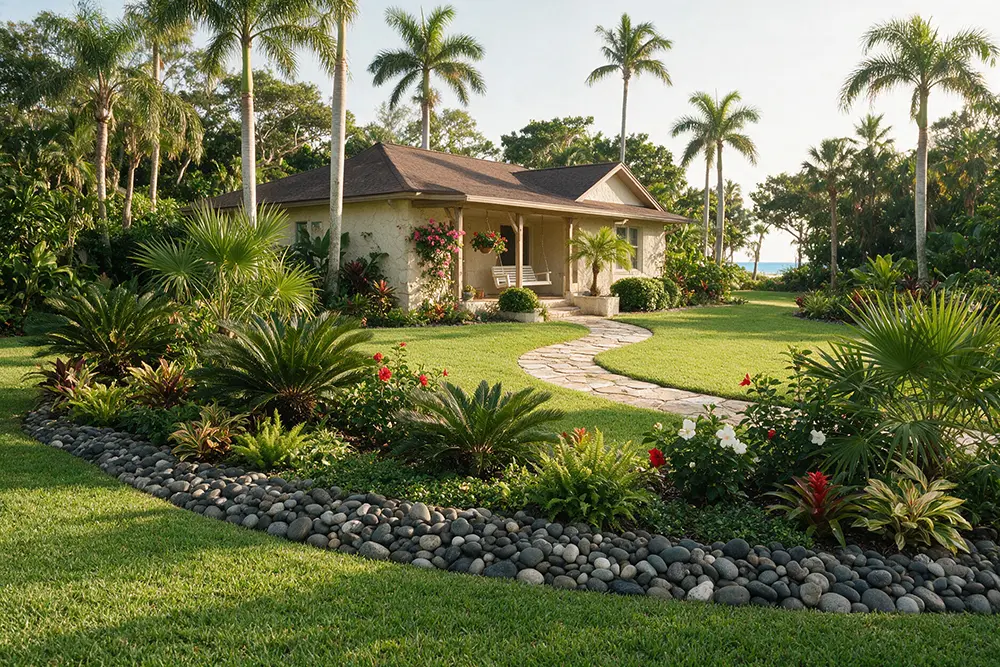
Its size and weight. Pea gravel and small river rock drift, settle, and let the landscape fabric poke through within a year. Mexican beach pebble does not. The stones are big and smooth, usually three to nine inches, in shades of black and gray, and that heft is the whole point. "A lot of people complain about their weed fabric showing, and that's because small rocks settle and push things up," Jesse told The Spruce. "These don't do that." He put the durability even more plainly: "Once we put it down, you don't really ever have to put it down again, because it doesn't move." There is a safety angle too. Flat slate turns slick the second it gets wet, but this pebble actually grips when the rain comes. It does not fade in the Florida sun, it rinses clean, and it holds up as a low water ground cover for xeriscaping when you want something that looks sharp without a watering schedule.
Can it really go around a pool deck?
Yes, and it is one of our favorite uses for it. If you are tired of grass creeping into the pool and mowing right up to the edge of the deck, a pebble border fixes both problems at once. Jesse walked The Spruce through how we do it. "You can run three or four feet around the exterior of the pool, put some palm trees in it, and it gives it a really nice look," he said. "It's fade-resistant and smooth but it still has that gripping quality, so it can be walked on." That grip matters more around a pool than anywhere else, because wet feet and slick rock are a bad combination. The black or gray stone also sets off the water and the deck instead of fighting them. We usually pair the border with the right plant design, a few palms or low plantings tucked into the pebble, so the whole pool area reads finished. You stop trimming grass along the waterline, and you stop tracking mud back into the house.
Does it need sealing, and is this a job for a pro?
Sealing is optional, but the install is worth handing to a crew that does it every week. The sealing part is easy to understand. "Some people call it rock glue," Jesse explained to The Spruce. "When the rock is naturally wet it looks glossy, and when it dries it goes back to a matte color. If you seal it, you get that shine all the time." You can seal it the same way you would seal pavers or a patio, so that is a call about looks, not function. The install is what people underestimate. The reason a cheap gravel job fails is almost never the rock. It is the prep. Fabric laid wrong, no real edging to hold the stone, a low spot nobody regraded. When we handle the hardscape install, we grade it, lay proper fabric, set a clean edge, and spread the pebble deep enough to hide the ground and stay where we put it. Do that once and you are finished, which is the entire appeal.
If there is a corner of your yard that washes out, won't grow, or just looks unfinished, Mexican beach pebble might be the answer, and we can tell you in one visit whether it fits your property. Call Citrus Landscape Solutions at (407) 759-1260 or request a free quote, and we will handle it the right way.