If your yard holds water after storms or feels uneven underfoot, new sod or turf alone will not fix it. Professional land grading shapes the ground first, so water drains away and everything you install on top has a solid, level start.
It is the step that decides whether a bigger landscape project lasts. To have someone look at your yard, reach out to our team or call (407) 759-1260.
How does correct slope move water away from your foundation?
A properly graded yard slopes gently away from the house, so rainwater runs toward the street, a swale, or a drainage area instead of collecting along the foundation. A common standard is about six inches of fall over the first ten feet out from the house.
When the slope runs the wrong way, water pools against the slab. Over time that can lead to damp walls, mildew, pest problems, and soil washing out from under walkways and patios.
Sanford's location makes this especially important. Many neighborhoods sit low and close to Lake Monroe, where the water table is high and heavy summer rain has fewer places to go. A yard that drains poorly here stays soggy for days after a storm.
Grading does not fight the weather. It simply gives the water a clear path out, so storms pass through the yard instead of settling in it.
Why does sod, turf, or a fence need a graded base to succeed?
Everything you put on a yard depends on the ground underneath. Sod needs even contact with the soil to root, turf needs a level, compacted base to drain properly, and fence posts need stable ground to stay plumb.
Sod laid over dips and humps roots unevenly. Low spots drown the grass and high spots dry out first, so the lawn turns patchy within a season. Turf over poor grading shows every bump and can hold puddles on the surface.
Sanford earned its old nickname, the Celery City, from farms that thrived in its rich, low-lying ground. Some yards here still sit on soil that stays wet long after a storm, which makes a properly graded base even more important.
Fences suffer too. Posts set in soil that stays wet loosen over time, and a fence line that follows an uneven yard can leave gaps underneath where pets slip out.
Our fence installation, plant design, and turf in Sanford all start with checking the grade, because the finished project is only as good as the ground it sits on.
What happens when a yard is planted over poor grading?
The problems come back, usually after the first big storm. Water still collects in the same spots, new sod rots or washes out, and you end up paying to fix the yard twice.
A homeowner in Sanford wanted new sod before his son's backyard birthday party. His little guy showed us where water collected after storms to form a little "lake," where he liked to play battleship. We talked through the drainage with the homeowner and explained that sod alone was not going to stop that water from coming back.
That is a common situation. Fresh sod makes a yard look finished on day one, but it cannot change where water flows. Only grading can do that.
Older properties near Sanford's historic downtown often have years of settling, tree roots, and added fill that have changed how the yard drains since the home was built. Correcting that before planting saves money in the long run.
How does a crew evaluate your site and set the right pitch?
A good crew starts by watching how water moves now. They check where it collects, where it enters the yard, and where it should leave, then measure elevations across the lot to plan the new slope.
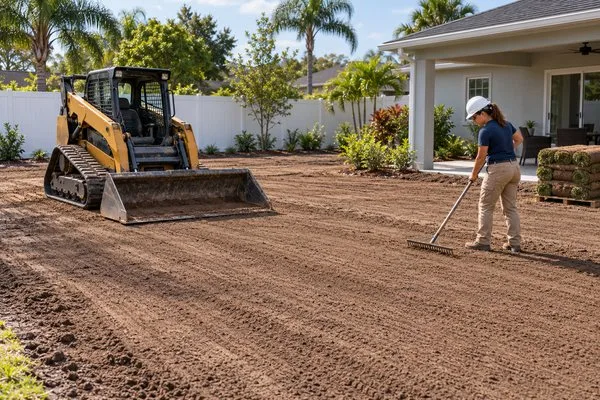
From there, they remove or bring in soil as needed, shape the yard to the planned pitch, and compact it so it holds that shape. Swales or gentle channels may be added to carry water along property lines or toward the street.
The last step is checking the result before anything is planted. Our grading and leveling work is measured against the plan so your sod or turf goes down on ground that drains the way it should.
Ready to fix your yard from the ground up? Call Citrus Landscape Solutions at (407) 759-1260, or request an estimate and we will schedule an assessment of your Sanford lot.