
A paver driveway done right holds up for decades. Done wrong, it starts moving, separating, and draining poorly within the first couple of years, and fixing a bad install costs more than the original job would have if it had been built correctly the first time. Citrus Landscape Solutions welcomes the vetting questions and will answer every one of them. Call (407) 759-1260 or request an estimate online and let us show you what a quality bid looks like.
Tampa homeowners replacing cracked concrete driveways typically receive quotes that range enough to raise real questions about what is actually different between the lower and higher numbers. Some of that range reflects legitimate cost differences tied to scope and material. Some of it reflects contractors who are building in margin by cutting corners on the installation steps that do not show on the surface. Knowing which questions to ask during the estimate process is what lets you tell the difference before the job starts rather than after the first rainy season reveals what was underneath.
What Should You Ask About Base Preparation and Edge Restraint?
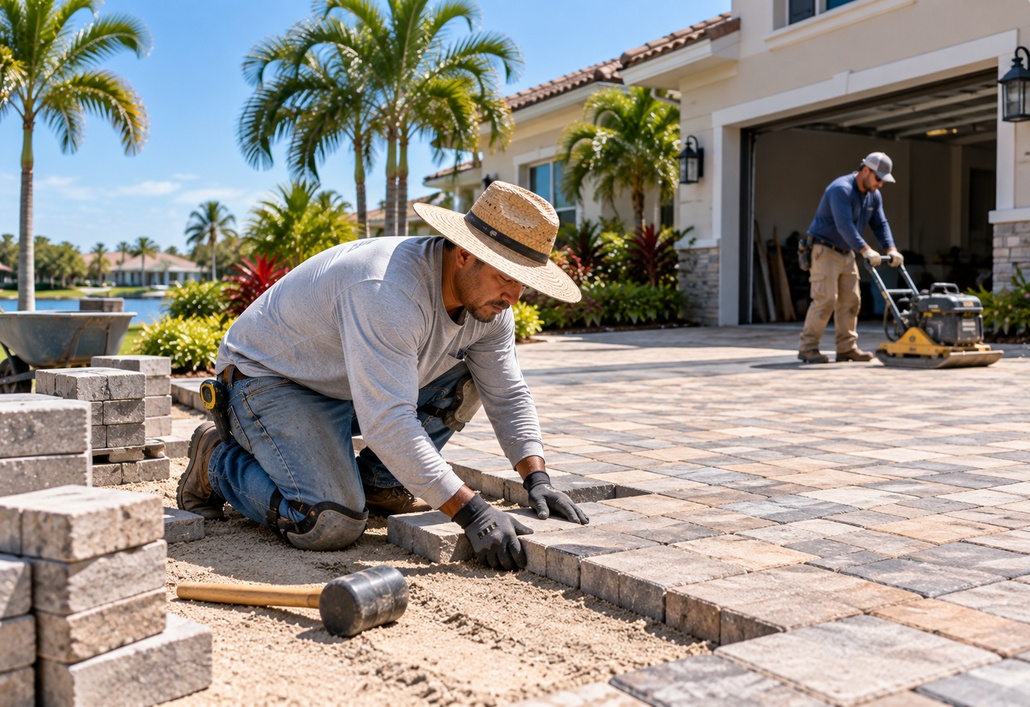
Base preparation is where most paver failures begin, and it is the part of the installation that is completely invisible once the pavers are down. A crew that skimps on excavation depth, uses inadequate base material, or skips compaction passes is creating a surface that will look fine on the day of installation and begin showing movement within one to three years as the improperly prepared base settles unevenly under vehicle loads and Tampa's wet-dry seasonal cycling.
Ask every contractor you are evaluating how deep they excavate, what base material they use, and how many compaction passes they run between lifts. The answer should be specific. A residential paver driveway in the Tampa area typically requires excavation to a minimum of six to eight inches below the finished grade to remove organic material and reach a stable subgrade, followed by a compacted limerock or crushed aggregate base of appropriate depth for the vehicle loads the driveway will carry. A contractor who describes their process in vague terms like "we do it right" without measurable specifics is not giving you the information you need.
Edge restraint is the component that keeps the perimeter pavers from migrating outward over time. Without a properly installed edge restraint system spiked into the base at the correct intervals along every exposed edge, the lateral pressure of vehicle traffic gradually pushes the border pavers away from the field, opening joints and creating the spreading look that signals an install built without adequate containment. Ask the contractor what edge restraint system they use, where it is installed, and how it is anchored. A correct answer describes specific materials and placement. An answer that does not include those specifics, or that dismisses the question, should carry weight in your decision.
What Permeable Options Should Tampa Homeowners Consider?
Tampa's rainfall averages make drainage a real design consideration rather than an optional upgrade. Hillsborough County properties deal with heavy summer rain events that can deposit several inches of water in a short period, and a driveway that sheds all of that water as runoff contributes to the drainage load on the street and the yard. Permeable paver systems address this by allowing water to pass through the joints and into the base aggregate below, reducing surface runoff and, in some cases, qualifying the property for stormwater credit under local utility programs.
Permeable systems use wider joint spacing filled with a clean aggregate rather than the polymeric sand used in standard installations, and the base aggregate is designed to hold and slowly release water rather than drain it away. They work well on driveways where the vehicle loads are manageable and the soil below the base has adequate infiltration capacity. They are not appropriate for every soil condition, and a site assessment that looks at the existing soil drainage before recommending a permeable system is the responsible sequence. Ask any contractor recommending a permeable option whether they have assessed the soil infiltration rate for the property, and be cautious of a permeable recommendation made without that evaluation.
Standard paver systems with good drainage design, meaning properly graded surfaces that direct water away from the house foundation and toward appropriate drainage outlets, handle Tampa's rainfall without the permeable specification and are appropriate for a wider range of soil conditions. The slope and drainage routing of the driveway surface should be part of any professional estimate, and a contractor who does not address drainage in the design conversation has not thought through the installation for Tampa's specific rainfall environment.
What Do Joint Sand and Sealing Decisions Actually Affect?
We worked with a family that had recently relocated to Tampa from out of state and was collecting estimates on their driveway replacement. They were comparing bids without a clear basis for understanding what was different between them, and when they called us we walked them through the specifics of what Tampa's weather requires from a paver installation that the contractors from their previous state might not have considered. The conversation covered drainage, joint sand selection, sealing, and base depth for Florida's soil conditions. That level of detail was not something they had gotten from the other bids, and it gave them a clear basis for confidence in the decision they made. They knew what they were paying for and why it was worth it.
Joint sand selection matters more than most homeowners realize. Standard sand in paver joints washes out during heavy rain events, which Tampa delivers regularly, leaving open joints that allow weed germination and accelerate the instability that follows when pavers begin to lose their interlocking relationship. Polymeric sand, which contains a binding agent that hardens when activated with water, resists washout significantly better and inhibits weed growth in the joints. A contractor who is not specifying polymeric sand for a Tampa driveway installation is either cutting costs at the homeowner's expense or does not understand why the material matters in this climate.
Sealing is a separate decision from joint sand selection and addresses the paver surface rather than the joints. A penetrating sealer protects the paver material from staining, enhances color depth, and reduces moisture absorption into the paver body, which matters for freeze-thaw resistance in colder climates but is less critical in Tampa. A surface sealer or wet-look sealer provides a more visible finish effect but requires reapplication on a regular cycle and can become slippery when wet if not specified correctly for a driveway application. Ask the contractor what sealing product they recommend, why they recommend it for a driveway specifically, and what the reapplication interval looks like. A contractor who lumps sealing into a generic "we seal it" answer without addressing the product type and application method for this specific use is not giving you a complete picture.
What Warranty and Portfolio Red Flags Should You Watch For?
A contractor confident in their installation offers a workmanship warranty that covers shifting, settling beyond defined tolerances, and joint sand failure for a meaningful period after installation. A warranty that expires the day the job is done, or that is so broadly worded that almost any claim falls outside its scope, is not meaningful protection. Ask what the warranty covers specifically, how long it runs, and what the process is for making a claim. Put the warranty terms in writing in the contract before work begins.
Portfolio review is the other vetting step that homeowners skip most often and regret most consistently. Ask every contractor for references from completed Tampa driveway projects, specifically from customers whose installs are at least two or three years old. A paver installation looks good the day it is finished regardless of how it was built. The quality of the base preparation, the edge restraint, and the joint sand shows up in the second and third year when the system has been through enough wet seasons and vehicle loading to reveal what is underneath. A contractor who cannot provide references from established projects, or who provides only recent installations, is not giving you the evidence you need to evaluate their long-term work.
A suspiciously low bid without a clear explanation of what accounts for the lower price is itself a red flag. Ask the contractor to walk through the bid line by line and explain the scope: excavation depth, base material and depth, compaction method, edge restraint type, joint sand specification, and whether permitting is included. If the explanation involves a shallower base, omitted edge restraint, or standard sand where polymeric is warranted, the low bid is low because something important was left out. That clarity, obtained before you sign anything, is worth the extra time the conversation takes.
If you are ready to replace your Tampa driveway with a paver installation built to hold up through Florida's weather, call Citrus Landscape Solutions at (407) 759-1260 or request an estimate online. Our pavers and hardscapes work is built to answer every question on this list, and our landscape design team can help you think through how the driveway fits the broader property plan while you are at it.