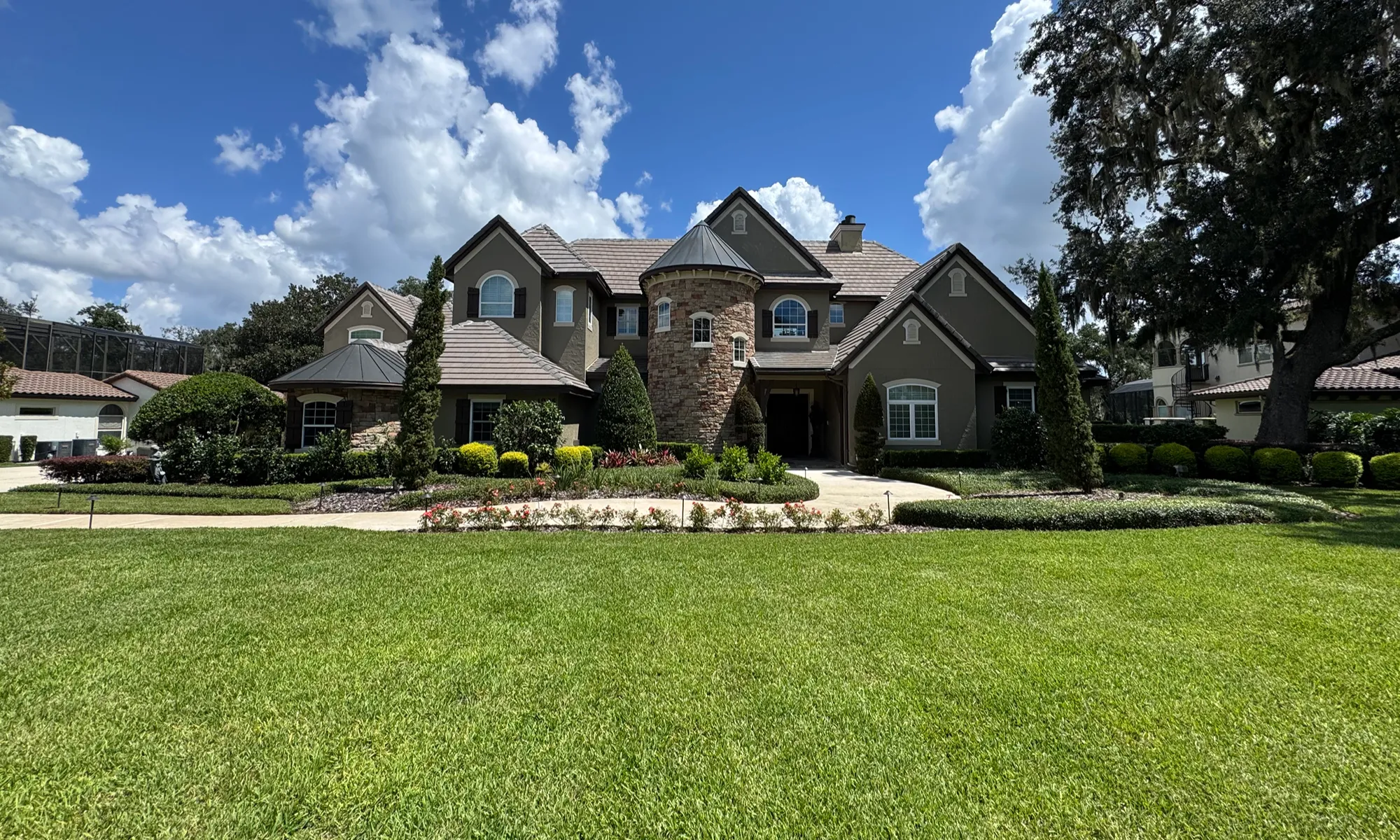
A well-designed landscape lighting system does two things at once: it makes a Sarasota property beautiful after dark and makes it safer for everyone who approaches it. If you are ready to see what your property could look like in the evening, Citrus Landscape Solutions offers consultations and nighttime demonstrations at (407) 759-1260 or through our online contact form.
Sarasota homeowners who invest in landscape lighting often describe the result the same way: the property looks better after dark than it does during the day. That outcome is not accidental. It reflects a design approach that treats the night landscape as a distinct composition with its own priorities, rather than a copy of the daytime view with some lights added. The same principles that govern that design also address the practical concerns that bring many homeowners to the lighting conversation in the first place: the curb appeal of a well-lit entry, the deterrence value of illuminated perimeter areas, and the simple safety of being able to see where you are walking when you come home after sunset.
How Are Path, Uplight, and Accent Fixtures Layered for a Complete Design?
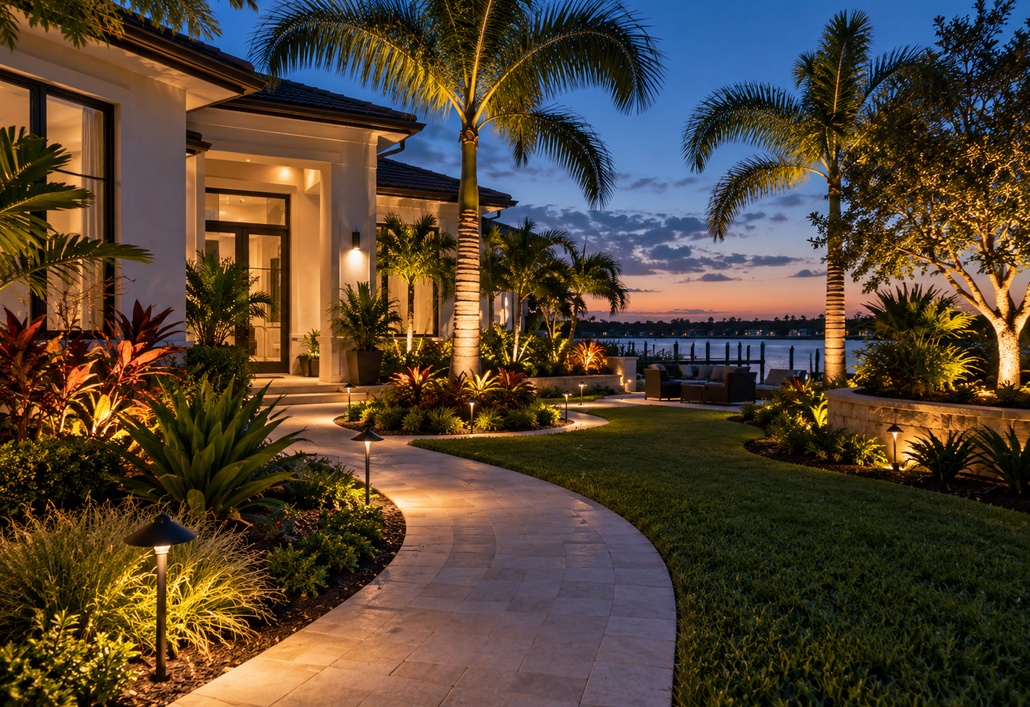
A landscape lighting design that works on both aesthetic and practical levels uses multiple fixture types placed at different heights and angles to create a layered effect that no single fixture type can achieve on its own. Path lighting, uplighting, and accent lighting each serve a distinct function, and the interaction between those layers is what produces the depth and dimension that distinguishes a professional design from a row of fixtures staked along a walkway.
Path lighting addresses the most immediate safety concern: illuminating the surfaces where people walk. Well-placed path fixtures light the ground plane clearly without creating glare that limits rather than improves visibility. A fixture that throws an even wash of light across the walkway surface allows the eye to resolve the path without strain. One that points a concentrated beam at eye level creates a blinding spot surrounded by relative darkness, which is worse than no lighting from a safety perspective. The spacing, height, and beam angle of path fixtures determine which of those two results you get, and those decisions belong to someone who understands how light behaves on different surfaces at different distances.
Uplighting brings the vertical dimension of the landscape into the nighttime composition. A mature live oak or a royal palm uplighted from the base becomes a visual anchor that draws the eye and defines the space in a way that no amount of ground-level lighting achieves. The fixture angle and the color temperature of the light determine whether the result reads as dramatic or natural, and for Sarasota properties where the landscape often includes mature specimen trees and tropical plantings, the uplight design choices are where the character of the evening landscape is established most powerfully.
Accent lighting fills in the composition by highlighting architectural features, entry pillars, garden walls, and specimen planting beds that deserve attention but do not require the same fixture approach as a large tree or a main pathway. Together, the three layers create a scene that has foreground, midground, and background, that guides movement through the property, and that presents the home as thoughtfully composed rather than generically illuminated.
Why Do Low-Voltage LED Fixtures Matter in Sarasota's Salt Air Environment?
Sarasota's Gulf Coast location exposes landscape fixtures to salt air that accelerates corrosion in materials not specified for coastal environments. A fixture that performs well in an inland installation may show rust, pitting, or seal failure within a few seasons in a property close to the water, and the cost of replacing failed fixtures repeatedly over a ten-year period exceeds the cost difference between standard and coastal-rated hardware at the time of installation. Specifying fixtures with marine-grade brass or stainless steel construction, sealed LED modules, and gaskets rated for coastal exposure is not an upgrade on a Sarasota property. It is the baseline specification for an installation that will still look and function correctly five years from now.
Low-voltage LED technology has transformed landscape lighting in ways that make it the clear choice for virtually every residential application. The energy consumption of a well-designed LED system is a fraction of what the same design would consume in halogen, which means the aesthetic ambition of the design does not have to be constrained by operating cost concerns. LED lamp life is measured in tens of thousands of hours rather than the hundreds or low thousands of halogen, which reduces maintenance frequency and the disruption of having fixtures go dark between service calls. Color temperature options in modern LED allow the designer to calibrate the warmth or coolness of the light to the specific planting and architectural context, rather than accepting whatever the lamp type produces.
One of our Sarasota customers came to us with a specific safety concern. She had her elderly mother visiting regularly, and the path from the curb to the front entry was not adequately lit. The concern was not aesthetic. It was the very real possibility of her mother missing a step or not seeing a change in grade in the dark. We designed a path and entry lighting plan that addressed every transition point along that route, ensured there were no dark gaps between fixtures, and eliminated the glare that can be as hazardous as darkness for older eyes. The system we installed gave her confidence that her mother could arrive safely regardless of what time the visit ended.
How Does Lighting Deter Intruders and Prevent Trips and Falls?
The security contribution of landscape lighting is most effective when it is designed rather than reactive. A single motion-activated floodlight at the garage door is a reactive approach: it responds to movement that has already occurred at close range. A designed perimeter lighting plan that illuminates the approach paths, the entry points, and the side yard transitions creates an environment where anyone approaching the property is visible from inside the house and from the street, and where the absence of dark concealment areas removes the opportunity that opportunistic intrusion depends on.
Consistent, low-level illumination of perimeter areas is generally more effective as a deterrent than bright lights that create high-contrast shadows. A bright spotlight creates a well-lit zone immediately in front of the fixture and deep shadows on either side, which can actually aid concealment rather than eliminate it. A gentle, even wash across the driveway, the side yard, and the entry path eliminates the shadow contrast that creates hiding places without producing the harsh glare that makes a property feel institutional rather than welcoming.
Trip and fall prevention is the other safety function that landscape lighting serves, and it is the one most directly tied to the design details. Grade changes, steps, raised bed edges, and patio transitions that are completely visible during the day become invisible hazards after dark when the surrounding area is lit but the transition itself is not. A lighting plan that specifically addresses these transitions, with fixtures positioned to cast light across the change in level rather than parallel to it, makes the hazard visible without requiring the viewer to already know it is there.
How Do Smart Controls and Timers Optimize the System?
A landscape lighting system without intelligent controls runs on a schedule that does not respond to actual conditions. A timer set in January runs the lights until the same time in June when sunset is ninety minutes later, which means the property is lit before it needs to be and consuming energy unnecessarily through the early evening. An astronomical timer that adjusts automatically to the actual sunset and sunrise times for the property's location solves this efficiently without requiring the homeowner to update the schedule as the seasons change.
Smart controls extend that efficiency further by allowing zone-by-zone adjustment from a phone app, the ability to schedule different lighting scenes for different occasions, and integration with security systems that can trigger specific zones when motion is detected. A homeowner who wants the full landscape composition active for a dinner party and a reduced, security-oriented subset of zones active after guests leave can configure both without programming two separate timer units. The flexibility also makes it practical to dim certain zones after a set hour to reduce light pollution and energy consumption during the late-night hours when full illumination is not needed.
Transformer capacity is the technical constraint that smart controls need to be specified around. A landscape lighting transformer should be sized to handle the current fixture load plus a margin for additions without operating at the edge of its rated capacity, which shortens transformer life and creates voltage irregularities at the far ends of the circuit. A designer who calculates the actual load of the specified fixtures and selects a transformer with appropriate headroom is building a system that can be expanded later without requiring a transformer replacement.
If you want to see what your Sarasota property looks like after dark with a designed lighting plan, call Citrus Landscape Solutions at (407) 759-1260 or schedule a consultation or nighttime demo online. Our landscape lighting and landscape design teams work together to produce an evening environment that is as considered as everything else about your property.